
What The Economist Got Wrong About Promoting Women
What The Economist Got Wrong About Promoting Women
Posted On: Wednesday, August 3, 2011
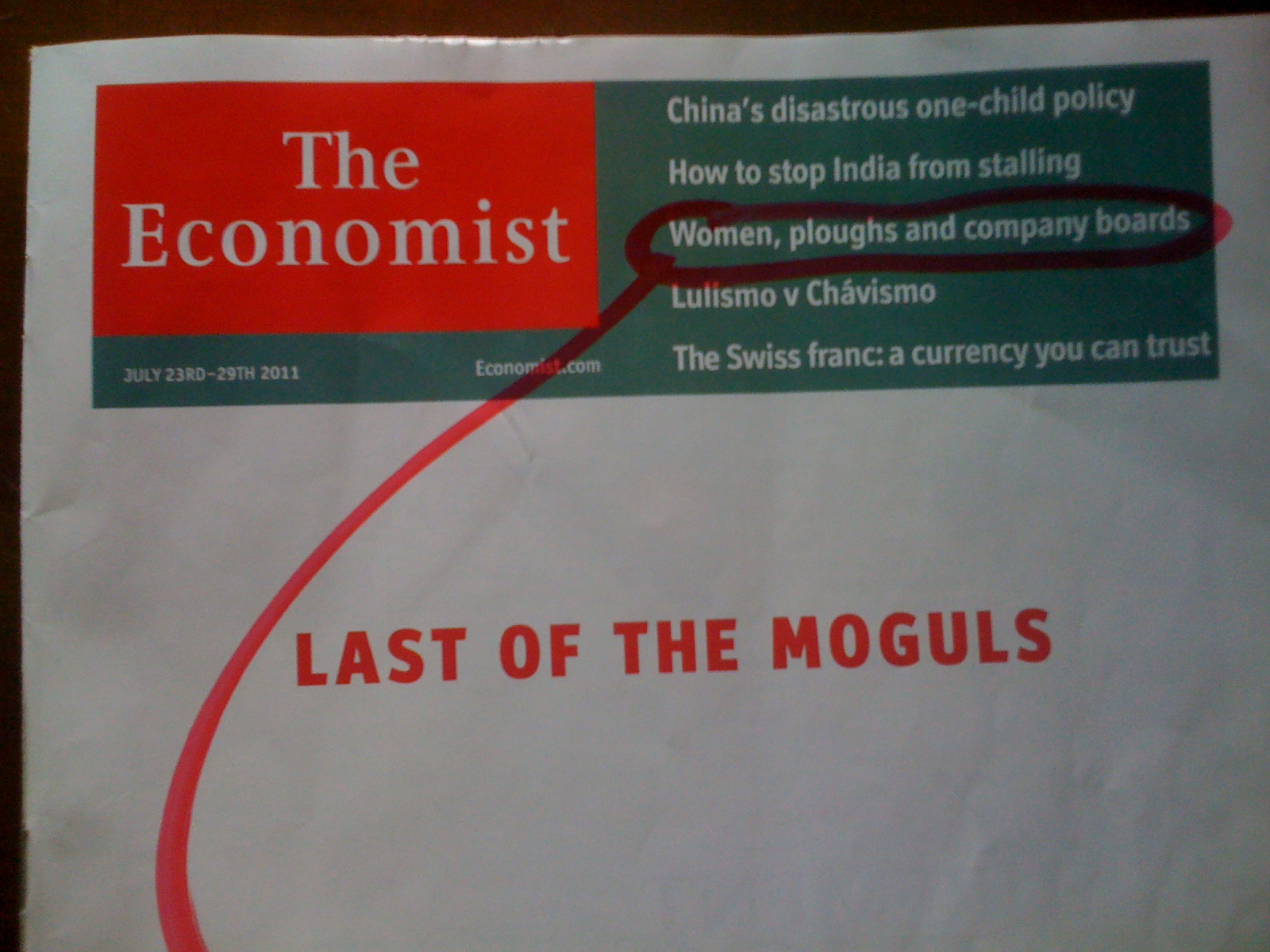 “The wrong way to promote women,” in a recent issue of The Economist, dismisses the serious inequity of women holding 1 out of 10 corporate board seats in Europe, and 1.5 out of 10 in U.S. companies by saying nurture, not a glass ceiling, holds women back.
Therefore, quotas — action many governments in Europe have taken in order to increase the representation of women on boards — are unnecessary and “do more harm than good,” according to the article.
In pushing its nurture thesis, the article creates a straw man: the real obstacles in a woman’s career are children, aging parents, and companies that aren’t sufficiently family friendly.
So what if you don’t have children and ignore aging relatives? What if you don’t make the mistakes done apparently by the caregiver stereotypes cited — disrupt your career by switching to part-time at some point, decline opportunities at night to network, or turn down assignments overseas to build experience — is advancement to senior management and subsequent consideration for board positions yours?
Well yes. No. Maybe? Once you overcome the pesky problem acknowledged that companies often want people who’ve had financial or operational experience for top positions and “these fields are still male-dominated.”
Prejudices, the article admits, “about women and work have deep roots,” but the author encourages companies to find ways to overcome all that. Being more family friendly to attract female talent is one way suggested. Telecommuting is offered as an example of the flexible thinking required. Who would have thought that was an express train to the boardroom?
The irony is that in trying to show what the alternatives are to governments imposing quotas to increase the representation of women on boards, the article offers no alternative except to admonish companies to figure out how to overcome the prejudice question “to win the talent war, and reap the rewards.” And that takes us back to square one.
Some companies have done a terrific job advancing gender diversity, and according to studies by Catalyst and others, experiencing financial rewards as well. But given that only 28 women are CEOs of Fortune 1000 companies and women hold only 15.7 percent of seats on corporate boards, we have an urgent problem that is shared by every other country.
Are quotas the answer?
It would be a heated but relevant debate. Out of which we are likely to get better public policy, and answers that go considerably beyond telecommuting.

Gael O’Brien is a catalyst for leaders leading with purpose and impact. She is an executive coach with a corporate and public affairs background. Gael is President of Strategic Opportunities Group.
Posts by Category
Archive
Most Recent
Gael O’Brien was the Keynote Speaker at the Second Annual Isenberg Ethics Competition at the University of Massachusetts at Amherst….Gael was both informative and inspiring. She challenged her audience to engage in self-reflection, while also providing the participants with many practical strategies for approaching business decision-making….